
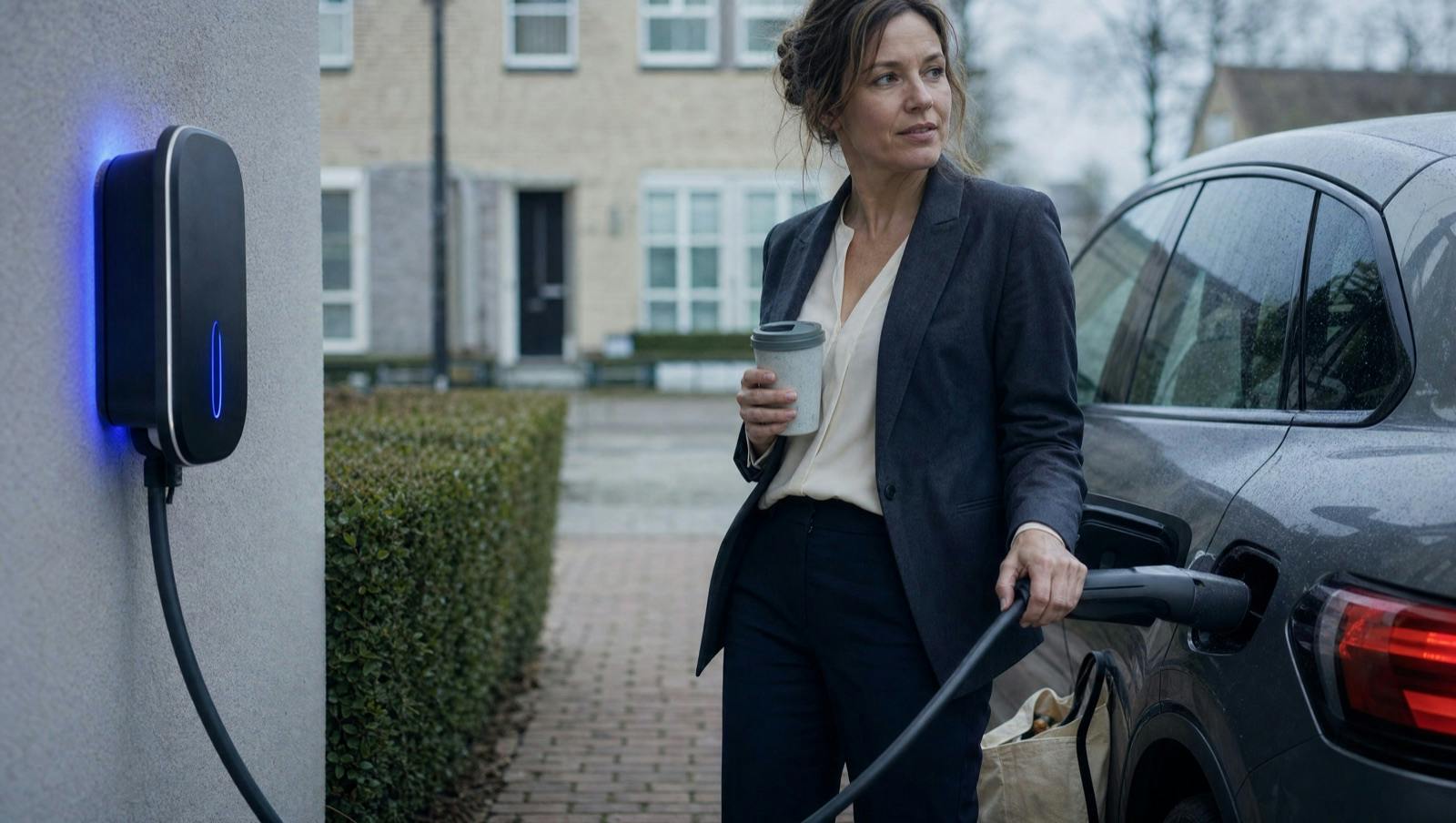
Yes, and this is the route
A private individual never reaches the threshold for booking in independently. That sits at 2 million kWh a year, and an average household charges a fraction of it. Your route therefore always runs through a service provider, which works with an alternative threshold: a provider booking in electricity from natural persons needs 200 authorisations rather than a kWh volume.
Your authorisation runs for at least one calendar year. Switching to a different provider is therefore possible from the next calendar year, not mid-term.
⚠️ If you come across a source saying home chargers cannot book in at all, it is out of date. Two answers in the NEa's questions and answers state exactly that, on the grounds that the domestic connection is in a private person's name. Those answers were last modified in 2022, before the ERE system existed. They are superseded by the Regeling energie vervoer, which explicitly provides the route via a service provider with the 200-authorisation threshold, and by the NEa's own 2025 answers, which assume home chargers can book in.
Four things that differ for private individuals
| Business | Private individual | |
|---|---|---|
| MID meter transitional year | Yes, until 1 January 2027 for those booking in with an external meter before 2026 | No, no transitional year |
| Renewable share | Grid average, or 100% with own generation meeting every condition | Always the grid average of 50.5% |
| Metering route | Exclusive connection or metered allocation point | Exclusive connection first, otherwise a MID meter inside the charge point |
| Booking in | Yourself from 2 million kWh, or outsourced | Always through a provider |
Four points where the private route differs. Source: NEa and the NEa questions and answers, with the thresholds from the Regeling energie vervoer.
No transitional year. Companies that booked in with an external MID meter before 2026 are not enforced against in 2026; for them the full requirement applies from 1 January 2027. For private individuals that grace period does not exist: the MID-certified meter must always be integrated into the charge point. A separate meter in the meter or fuse cupboard does not suffice.
Always the grid average. You book in at the grid-average renewable share, set at 50.5% for 2026. Even with solar panels on your roof. The position of the Dutch Ministry of Infrastructure and Water Management: "Home chargers always go via the grid, which means the use of solar panels is not encouraged. Moreover, this is not the right instrument with which to encourage the use of solar panels." Why that is so, and what it does mean for businesses, is worked out on what a charge point earns.
The precedence rule almost nobody explains. For a home charger the exclusive connection is the first route, and the MID meter inside the charge point is what remains. The NEa: "If no exclusive connection is present at a home charger and one cannot be installed, booking in is only possible if the charge point has a MID-certified meter." In practice: if you have no separate connection for your charge point and cannot have one installed, everything hangs on the meter inside the charge point itself. The full requirements are on MID certification and metering requirements.
Compulsorily through a provider, with the 200-authorisation threshold as its basis. That is not a choice but the construction the system has placed private individuals in.
Who may grant the authorisation
This is where it comes unstuck in practice, and the answer is counter-intuitive: not the owner of the charge point and not the driver of the car, but the offtaker on the connection.
You must be registered as the offtaker on the connection in the grid operators' central connections register, and the grid operator's data is decisive there, not your own records or your purchase receipt.
Three situations where that distinction matters:
- You rent and the charge point belongs to the landlord. What decides it is whose name the connection is in. If the electricity connection is in your name, you are the offtaker, even where the charge point is not your property.
- The charge point was installed through your employer. Again: the connection decides. With a domestic connection in the employee's name, that is the employee.
- You live in a flat with a shared connection. Then the homeowners' association qualifies, provided the main grid connection is in the association's name and electricity is supplied to transport at that location. How that works out in practice is shown by a homeowners' association with shared charge points claiming ERE’s.
⚠️ One related question falls outside this page. If you drive a lease car or a company car and charge it at home, arrangements with your employer or leasing company come into play, and possibly tax consequences for the payment you receive. That is its own subject requiring its own assessment; we do not cover it here and give no answer on it.
Double claims: why one authorisation with one party
If a leasing company or charge card provider is already booking in the same charging sessions, the NEa rejects the claim. The same kilowatt-hour can only be booked in once.
In practice: give your authorisation to exactly one service provider, and check whether anything is already being done with your charging sessions via your charge card, your employer or your lease contract. That is not always visible in your own overview.
A booking that fails the annual verification probably pays out nothing: it is investigated first. Booking in is voluntary but not without obligation; on rejection the NEa can determine the position of its own motion and demand correction. What to look for when choosing a provider is covered in how to choose an ERE service provider.
Is it worth it at an average charging volume?
Honest answer: it is a side income, not a business model. And that honesty is exactly what to watch for in providers.
Work it through. A household supplying between 2,000 and 3,500 kWh a year to the car arrives, at the grid average of 50.5%, at roughly 665 to 1,165 ERE’s a year. Calculating at the current market price, €0.32 per ERE (as of 16 Oct 2026), that is roughly €216 to €378 a year gross, before a provider's fee.
That amount is an indication and not a promise. There is currently no ERE price: the Register Energie voor Vervoer is still closed and no ERE’s are being traded. Every amount per kWh quoted today, by anyone, is an assumption. The number of ERE’s you earn is fixed, because that follows directly from your charging volume.
So anyone holding out an attractive fixed payment per kWh to you as a private individual is making a claim about a market that does not yet exist. That is the signal to watch for.
Want to know what it yields in your situation?
This is how Voltico's ERE service provision works for home chargers, from the authorisation through to payout.
What Voltico does for you here
As a home charger you do not have to arrange anything with the NEa yourself: Voltico checks your authorisation and your connection, registers your charging sessions and pays out periodically. No upfront costs, and we pay for the verification.