58 days left to choose for 2026. Our advice: arrange it before 31 December. Get started for 2026
Solar panels on your business roof? Count them.
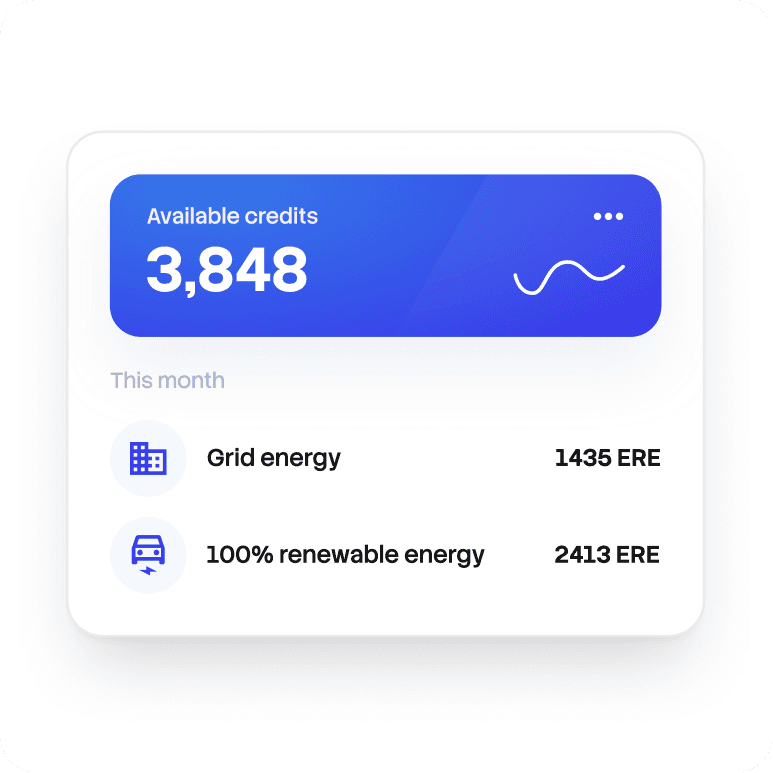
Grid electricity counts as 50.5% renewable, your own generation as 100%. That can roughly double the number of ERE's, if your setup meets the NEa's conditions.
No obligation. Maarten or Steven works it out with you.
Who is it worth it for?
For businesses with a large-consumer connection and substantial charging and generation volume: a charging hub, a depot, a distribution centre or an office with its own solar. The 100% route needs extra verification, which is charged per connection. For a small installation that rarely outweighs the extra ERE's; then you register on grid electricity.
- Grid (50.5%)3,326 ERE's
- On-site generation (100%)6,588 ERE's
Gross about €0.10 per kWh on grid electricity and €0.21 on own generation, as of 16 Oct 2026. An indication, not a promise.
Two routes to 100%
Generation at the same site
The panels and the charge points are on the same WOZ property.
Through a direct line
The generation is on another WOZ property, with another owner, and supplies the charging connection through a direct line.
The NEa conditions
Solar, wind or hydro
Biomass and biogas do not count.
Guarantees of Origin
A Guarantee of Origin for non-grid supply matching the registration, at most a year old, from the same address. Those GOs go to the NEa.
The right meters
A MID meter in the charger and a gross production meter on the generation, with a green EAN code from your grid operator.
Per hour, not per year
Generation cannot be netted against charging over the year. You show per hour that the electricity went to your vehicles.
No feed-in
Electricity you feed back into the grid cannot be registered.
With a battery
Allowed, if you show that the stored electricity was then supplied to vehicles.
It comes down to the hour
The NEa looks per hour. Only what you charge in the hour your panels generate counts as 100%. The rest counts as grid electricity, at 50.5%. The more charging and generation coincide, the higher your renewable share.
- Grid only50.5%
- Own solar, ±50% of charging coincides with generation±75%
- Sessions shifted towards midday, ±67%±84%
- With a battery covering the evening, ±99%±99%
Share of your charging that counts as renewable. Worked example with fictional figures. If you mostly charge at night, like many transport companies, little coincides without a battery. In winter simultaneity is always low.
And your SDE++ subsidy?
You may not receive an operating subsidy on the installation over the registration period. The year of your grant decision (on the RVO letter, not the year of construction) decides what is possible.
Grant decision before 2024
No 100%. Still 50.5%, like grid electricity.
Grant decision 2024 or later
100% is possible. Since then SDE++ only covers grid supply.
No SDE++
100% is possible.
Arrange two things now
Switch on hourly data for your charging sessions
Without hourly data you cannot show per hour that your solar power went to your vehicles. Chargers that do not pass on hourly data only count at the grid average.
Have a gross production meter installed
Without a gross production meter on your generation there are no GOs for non-grid supply, and so no 100%. You request it from your grid operator; allow up to three months.
What our software does
We see in real time whether a charging session runs on solar, battery or grid, and allocate every kWh in that order. In the portal you plan when charging yields the most.
What you provide
When you sign up: the metering company that reads your gross production meter, your installer's single-line diagram, the year of your subsidy and consent to transfer your GOs to the NEa. With a battery also your energy management system details and the capacity.
This applies to business installations. A home charger always counts at the grid average: according to the ministry, home charging always runs through the grid.
How it works
Transfer your GOs
You transfer your GOs for non-grid supply to the NEa via VertiCer. We calculate how many from your charging and generation data.
Confirm in the portal
You confirm the transfer in the Voltico portal. Only then can 100% be registered.
We register and sell
We register the ERE's with the NEa, sell them and pay you out.
How the metering is installed
Make room
Your installer makes room around the main busbar for the current transformers.
Fit the current transformers
On the cables of the generation and of the charge points.
Connect a calibrated meter
A calibrated MID or gross production meter on those transformers.
Check and seal
The metering company checks the installation and seals the meter.
- All rates and conditions
What the 100% route costs
The extra data check for the 100% route is included in the service fee. Only if the verification body sees cause is there a site visit: €950 per location. If nothing has changed since the last visit, a new one is usually not needed.
- Watch the webinar
The whole story in an hour
Sten from Voltico and Enerzien show why own generation counts double, which meters you need and what a battery does.













Questions about on-site generation


Experts in the ERE market
Our team knows the ERE market and makes sure your sign-up runs smoothly.
Choose before 31 December for 2026.
That leaves time to connect everything. Thousands of customers went before you.