EREs for transport companies: how they strengthen the business case for electric driving

Maarten · CEO & Co-Founder
How transport operators can turn e-truck charging into additional income through ERE credits, and strengthen the business case for electrification.

Contents
Electric trucks demand serious investment. But charging them can also produce an additional income stream. Through emission reduction units (ERE's, also known in the market as ERE credits), transport operators can extract financial value from their EV charging data. How does that work, what can it yield, and what should you watch out for? Maarten Poot, co-founder and CEO of Voltico, discusses it on the podcast Stroomversnelling by Kenter & Groendus.
Electrification is on the agenda at a growing number of transport businesses. But making the switch to electric trucks involves far more than buying the vehicles.
Charging infrastructure, grid congestion, batteries, solar panels, subsidies, metering and the overall business case are all interwoven. Since 2026, emission reduction units (ERE's) have joined that list. A relatively small part of the total energy system, but one that can contribute meaningfully to the business case for electric transport.
Kenter Groendus is an all-in-one sustainable energy partner for the business market. On its podcast Stroomversnelling, Jeroen van Denderen talks to Maarten about what ERE's can mean for logistics operators.
What are ERE's?
ERE's are tied to the emission reduction achieved through, among other things, the use of electricity for transport. The system gives that emission reduction a financial value.
For transport operators, this means that electricity used to charge electric trucks can generate additional income, provided the conditions are met. Registering ERE's yourself is possible from a charging volume of 2 million kWh, but even then, engaging an emission credit service provider is often still more attractive, given the verification costs and the specific legislation involved. Service providers also take the administration, verification, registration, trading and payout off your hands. See how we work.
What can ERE's yield for an e-truck?
The ERE payout depends on several factors, including the market price and how the electricity used was generated. In the podcast, Maarten works with the ERE values as they stood at the time of recording. For an electric truck charged mainly on its own site each day, that already adds up on grid electricity alone. That makes ERE's a relevant part of the total business case, alongside other schemes and the financial effects of electrification.
One caveat: the value of ERE's is set by supply and demand and can therefore fluctuate. No payout is guaranteed. Read more about how the price of ERE's is determined.
Own solar panels? The payout can rise further
For transport operators with their own renewable generation, the ERE business case can become more attractive still. Under the right conditions, own generation, with solar panels for example, can roughly double the number of EREs, which starts to pay off from around 100 MWh of charging and generation per year. Conditions do apply. Metering, Guarantees of Origin (GOs), any SDE subsidy, and the simultaneity of generation and charging all play a part.
A battery can be part of this ERE optimisation too. For example, where solar energy is stored during the day and used later to charge electric vehicles.
That is exactly why designing a charging hub is not just about the charge points. How solar panels, batteries, meters and charging infrastructure are configured partly determines which data can later be used to register ERE's.
From charge point to payout
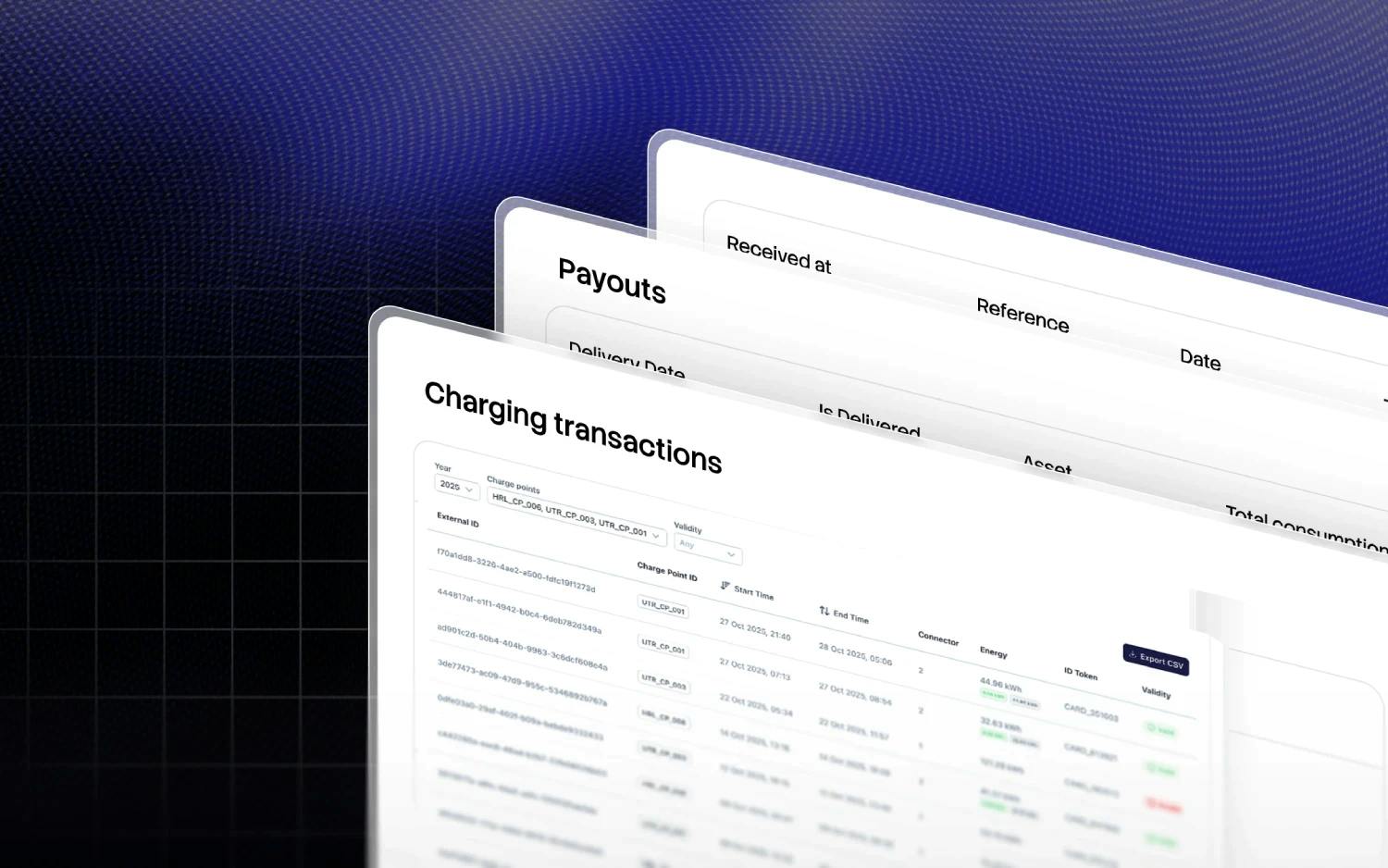
For a transport operator, ERE registration should above all not become another administrative process. So Voltico automates as many steps as possible: from onboarding and connecting charging systems to collecting and validating data, registering the ERE's, and paying out the proceeds.
Through integrations with charging platforms, charging data can be processed automatically. The principle: once the systems are properly connected and the overview is complete, an operator no longer has to supply manual exports or Excel files. That burden is a large part of why HBE's, the predecessor to ERE's, were often less attractive.
Do not wait until the end of the year
Perhaps the most important advice from the podcast is also the simplest: start on time. Charging sessions from 2026 can, under conditions, be carried across the year, but the required data and metering have to be in order. Service providers also need enough time to process the data. Supplies from the preceding calendar year must be registered in the REV before 1 March.
Already running e-trucks and charging infrastructure? Check in good time whether:
- your charge points have the right metering;
- your charging data is available and retrievable;
- your charging platform can be integrated;
- your own solar panels and any battery storage are correctly configured;
- your administration meets the conditions for ERE's.
Still designing your charging hub? Build ERE's into the design from the start. Adjusting meters or the technical configuration afterwards can be needlessly complex and expensive.
ERE's are part of a larger business case
You do not buy an electric truck for the ERE's alone. But if you are investing in electrification, it would be a waste not to capture the financial value of your charging data. Electric trucks, charging infrastructure, solar panels, battery storage, subsidies and ERE's increasingly form one integrated business case. Looking at those parts together from the outset gives you a more realistic picture of what electrification actually costs and returns.
As Jeroen puts it in the podcast: ERE's may no longer be just the cherry on the cake, but a serious slice of it.
Want the full conversation? Listen to the full Stroomversnelling episode from Kenter & Groendus with Maarten Poot.
What Voltico does for you here
Voltico automates the whole path from charging data to payout, including matching your own solar generation to your charging sessions. You don't need to keep your own records or supply Excel exports. Work out what your charge points could earn.
ERE price
10.81ct/kWh
−13.33% week/weekMarket price, not your net payout.
View the price index