Insights
From charging session to payout of ERE-certificates: how the Voltico platform works

Behind every ERE payout lies an automated, precise process. In this article, we explain how the Voltico platform works: from your first charging session to the monthly payment in your account.
Claiming Emission Reduction Equivalents (EREs) sounds simple: you charge your car and receive income. But behind that simplicity lies a complex, regulated process. The Dutch Emissions Authority (NEa) sets strict requirements for the conditions underlying every registration. Errors or incomplete data can lead to rejection or non-payment of EREs.
Voltico is built specifically to automate that process entirely: compliant, accurate, and without any effort on your part. Below we will walk you through how this works, step by step.
1. Connecting and authorizing
The process starts with connecting your charging point to the Voltico platform. Through a secure authorization process, you give Voltico access to the charging session data from your charging point. Voltico will never ask for passwords to back-office accounts. You remain in control at all times: the connection can be removed at any moment.
During the connection process, we run a series of verifications: we check the EAN number of your connection, the location, the type of charging point, and the ownership situation. Only charging points that meet all requirements are activated for ERE processing. This prevents issues from arising later during verification by the NEa and its accredited verifiers, both for you and for other customers.
2. Automatic retrieval and validation of charging sessions
Once your charging point is active in our system, charging sessions are ingested automatically. Each session is then validated across multiple criteria before being processed further.
We check for, among other things:
Duplicate transactions: every session is processed only once, even if the same data arrives multiple times.
Implausible values: sessions with unusual energy amounts or timestamps are excluded.
Missing data points: only complete and consistent sessions are eligible for registration.
Charging sessions that pass all checks are forwarded to the next step in our platform.
3. Registering charging sessions with the NEa
Validated charging sessions are queued in our system for registration. The registration takes place per EAN connection, in line with NEa requirements.
The EREs are then registered on behalf of all customers in the Register Energie voor Vervoer (REV), the official register managed by the NEa. As an accredited registration service provider, Voltico is authorized to perform these registrations on behalf of customers.
For processing, we use a double-entry bookkeeping system. Every transaction is recorded on two sides: the origin and the destination of each value. Both sides must always balance exactly, which means every mutation is fully traceable, nothing can appear out of nowhere, and errors are immediately visible. This is the same principle used by banks and financial institutions for maximum auditability. Because the NEa rounds down the number of EREs per registration to whole numbers, we allocate these to customers with four decimal places of precision, ensuring the distribution is as fair as possible.
4. Selling EREs on the market
Once the EREs are registered, they are bundled with volumes from other customers and sold on the market. By aggregating volumes, we can negotiate better prices than individual parties would be able to achieve on their own.
We trade EREs periodically and aim for the best available market price at the time of sale. The ERE price fluctuates, like other commodity markets, based on supply and demand. You can read more about ERE pricing in our article on how the price of Emission Reduction Equivalents is determined.
5. Automatic payout to you
After the EREs are sold, the proceeds are automatically transferred to your bank account. By default we pay out quarterly; monthly payouts will be available soon.
Keep in mind that the NEa register closes in the first months of each year for the annual close of the previous year. Once it reopens around June, EREs can be registered and paid out again. For 2026, we therefore expect the first payouts in the fall.
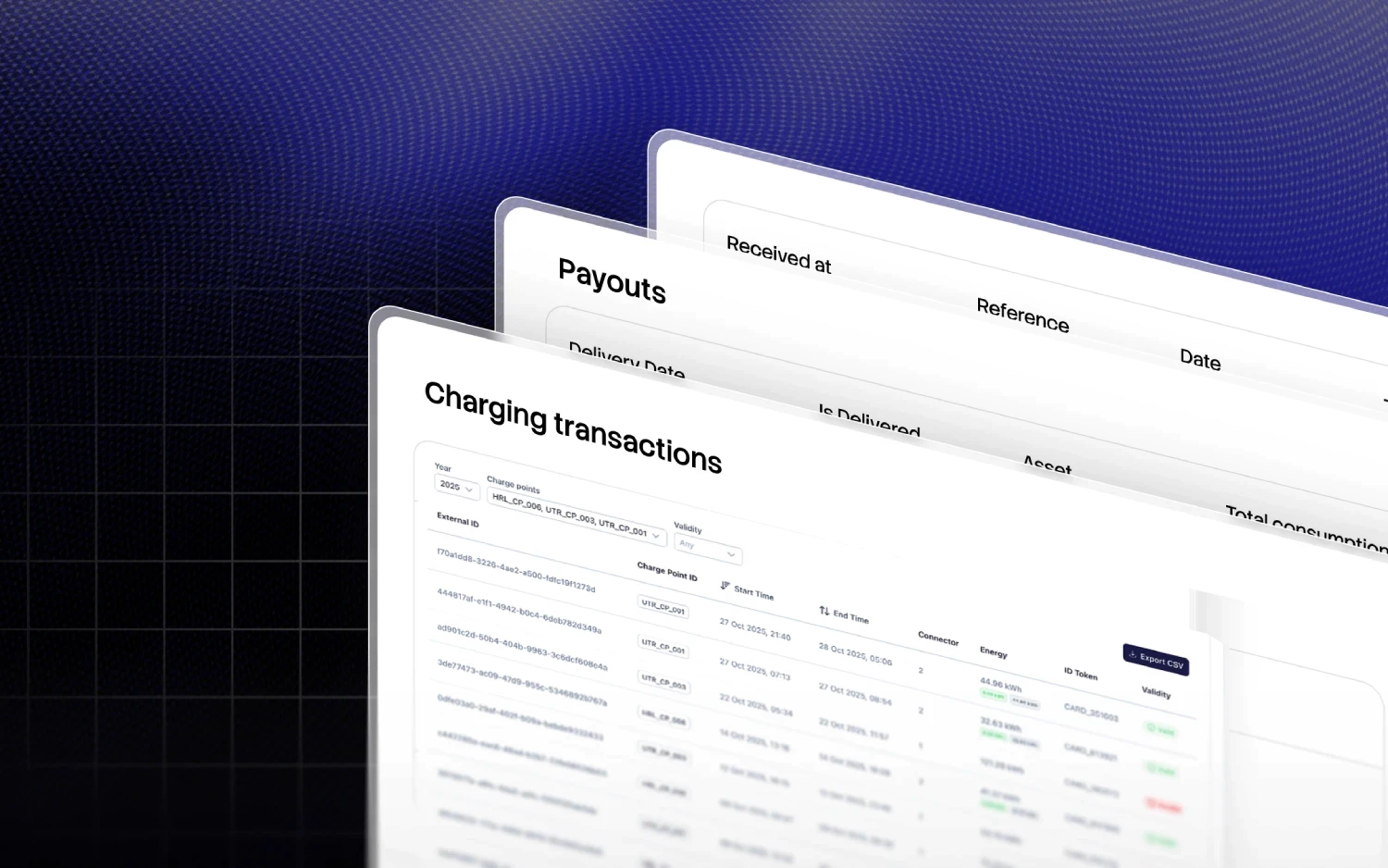
In your Voltico portal, you can see in real time how many kilowatt-hours have been charged, how many EREs have been registered and sold, and what the payouts are per period. You can also download a payment statement for your own records.
Reliability and availability
Our platform is designed for an availability of at least 99.5% per year. Because the processing of items in the system is largely set up asynchronously, a brief interruption never affects the completeness of your data: missed charging sessions are automatically recovered once the connection is restored.
We monitor our systems continuously and in real time, from the processing queue to individual connections. Any deviation triggers an immediate alert to our team.
Security and privacy
All connections are encrypted. Access to our internal systems is restricted to authorized staff via a secured private network. We enforce company-wide two-factor authentication and run automated security checks with every software change, as part of the broader suite of automated tests we already run for other purposes.
Our infrastructure is hosted in the EU. Your data therefore always stays within the European Union and is processed in accordance with GDPR requirements.
In summary
The Voltico platform ensures that the entire journey from charging session to payout is automated, compliant, and auditable, without you having to think about it. Want to know what this could mean for your situation? Calculate your potential ERE income using our calculator, or get in touch.